When I first got to BFITS, I felt thrilled—but I also carried a few doubts with me. Throughout training, one name kept popping up: Thammasat KlongLuang Wittayakom (THK) School. People would say things like, “THK is in a league of its own,” or “You’re in for quite a ride,” usually paired with a half-smile that felt more like a warning than reassurance. It sounded like things were about to get wild.
Naturally, I braced myself for chaos: strict rules, students who would push every button, and that familiar new-teacher survival mode. I wondered if I was really ready for this. The funny thing is, I’d already been living and teaching in Thailand for over eight years. I thought I understood Thai culture inside and out. I knew how schools worked, how students behaved, the jokes, and even the things that were never said out loud. Thailand didn’t feel new to me at all. It felt like home.

But being a teacher in Thailand and starting at a new school is different. No matter how much experience you have, walking into a new environment still makes your stomach flip. New students. New colleagues. New routines. New expectations. You have to observe, adjust, and slowly find your footing. Experience helps, sure—but it doesn’t erase the nerves.
Walking into THK, I felt that familiar mix of excitement and uncertainty. I tried to look composed and professional, but inside I was thinking, Alright… let’s see what “something else” really means.
First Days in the Classroom, Real Doubts

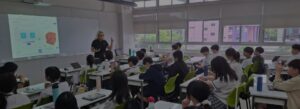
The students were curious. Some were shy. Others were loud. A few tested boundaries right away, while some stared at me like I was an alien who could speak English and Math at the same time. Honestly, it was a lot to take in.
Teaching Math in English, especially when English isn’t the students’ first language, goes far beyond numbers. It requires confidence, patience, clear communication, and trust. You can’t just walk in and start throwing formulas on the board. You have to help students believe that they can understand them.
At first, I focused on structure. Clear routines. Consistency. Clear expectations. I wanted students to know I was approachable, but also serious about learning. I assumed the connection would come later.
I was wrong.
How Trust Quietly Took Shape

Somewhere between explaining probability and working through compound interest problems, something shifted. Students started asking questions without fear. They laughed more. They stayed after class to clarify concepts. They began sharing small stories about their lives.
Then one day, a student casually called me “mom.”
I stopped. I laughed. And then it hit me how meaningful that moment was.
In many classrooms, teachers remain distant figures—respected, but not deeply connected. Here, my students were beginning to see me as more than just “Miss Math Teacher.” They trusted me.
That trust wasn’t forced. I never asked for it. It grew naturally once students felt safe.
Over time, they started coming to me with personal things—stress, friendships, worries about exams, random teenage thoughts, and dreams for the future. Sometimes it happened during break. Sometimes after class. Sometimes in passing conversations.
That’s when I realized something important.
Becoming More Than a Teacher in Thailand

Being a teacher isn’t just about teaching.
You become a listener. A guide. An older sister. Sometimes, even a stand-in parent. And occasionally, the person who helps students through moments they don’t yet know how to handle on their own.
One of my favorite things was when students treated me like a friend—but still respected me as their teacher. They joked with me. They tried teaching me Thai expressions. But when it was time to work, they focused. They listened. They followed directions.
That balance is rare. And it’s powerful.
Learning Beyond the Classroom Walls

One day, I found myself playing badminton with my students. If you had told me earlier that I’d be sweating under the Thai sun, laughing with students like we were teammates, I wouldn’t have believed you.
But there I was.
And it clicked.
Learning doesn’t only happen inside classrooms. Trust is built in moments like these. When students see you as a real person, they open up more. When they know you care about more than grades, they try harder. When they feel respected, they give respect back.
THK students come from different backgrounds, cultures, and personalities. At first, that diversity felt overwhelming. Later, it became one of the best parts of my job.
Some students are loud because that’s how they express excitement. Some are quiet because they’re processing everything in a second language. Teaching here taught me patience, empathy, and adaptability—not just as a teacher, but as a person.
Training the Brain Like a Muscle

Teaching Math in English to Thai students isn’t easy. Concepts that are already challenging become even harder when language is involved. Early on, I constantly asked myself: Am I explaining this clearly enough? Are they really understanding?
So I adjusted.
I simplified my language. Used visuals. Gave real-life examples. Added games. Slowed down. Repeated things when needed. Checked understanding constantly.
I also introduced a metaphor that stuck.
I told them math is like going to the gym. Your brain is a muscle. If you don’t use it, it won’t get stronger. At first, practice feels hard and exhausting. But over time, patterns become familiar. Steps feel automatic. Concepts start to click.
“Joining a gym but never touching the equipment doesn’t help,” I’d joke.
Some laughed. Some rolled their eyes. But they practiced—and they improved.
And then came those moments every teacher lives for: when a student’s eyes light up because they finally get it.
Rising Together Through Competition

One of the most unforgettable experiences at THK was the Math Project Competition. I never expected us to win—let alone advance to the national level.
Preparing students wasn’t just about math. It involved research, teamwork, presentations, confidence, and belief in themselves. We trained. We adjusted. We rehearsed. We laughed. We stressed. We grew together.
During the regional competition, I watched my students present confidently, answer questions thoughtfully, and think on their feet.
Afterward, one student looked at me and said, “You look so proud.“
I was.
That moment—watching them succeed—was overwhelming, and that success felt personal. Not just because of the result, but because of everything we built along the way. Trust. Effort. Connection.
Finding Belonging While Teaching in Thailand

Looking back, I smile at how nervous I was in the beginning. Yes, the BFITS Program in THK is “something else.” But not in the negative way people warned me about.
It’s special because of the students.
It’s special because of the community.
It’s special because it pushes you to grow.
Being called “mom” has nothing to do with age. It means students feel safe. It means they trust you. That trust is both an honor and a responsibility.
I never aimed to be their mom. I aimed to be kind, fair, consistent, and human. Somehow, that was enough.

Over time, my students grew academically while I grew emotionally and professionally. They learned Math, English, and confidence. I learned patience, humility, and deeper communication.
At first, when you decide to teach in Thailand, you will feel like a guest. Then part of a team. Then one day, you realize—you belong.
BFITS training prepared me professionally.
THK transformed me personally.
Would I do it all again?
In a heartbeat.
Because sometimes the most meaningful journeys begin with uncertainty—and the most rewarding destinations aren’t found on maps, but in the connections we build along the way.