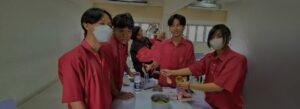
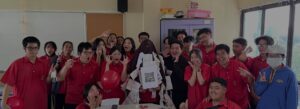
The Tanghulu STEAM Experiment is a hands-on food science activity that helps students understand sugar crystallization, concentration, and chemical reactions in candy making. In this supervised classroom or laboratory activity, students prepare candied fruit while testing how different sugar-to-water ratios affect the final coating. It is a fun way to connect chemistry, food preparation, creativity, and scientific observation.
📘 Overview
Tanghulu is a traditional Chinese candied fruit snack known for its glossy, crunchy sugar coating. In this STEAM activity, students study how sugar syrup changes when heated and cooled, and how concentration affects texture, hardness, and crystallization. The project turns food preparation into a meaningful investigation of chemistry, physics, art, and communication.
This activity focuses on the question: How does the concentration of sugar in the syrup affect the crystallization process and the texture of the Tanghulu coating? Students compare low, medium, and high sugar concentrations, observe the results, and connect their findings to sugar molecules, saturation, crystallization, caramelization, and molecular bonding.
🎯 Learning Objective
- Students will understand how sugar concentration affects crystallization.
- Students will observe how heating changes sugar syrup.
- Students will compare the texture of Tanghulu coatings made with different sugar-to-water ratios.
- Students will connect sucrose bonding, saturation, and crystallization to candy making.
- Students will apply STEAM skills through experimentation, documentation, microscope observation, and video presentation.
🧪 Materials

- Fresh fruits
- Examples include strawberries, grapes, or hawthorn berries.
- Examples include strawberries, grapes, or hawthorn berries.
- Wooden skewers or sticks
- Used to hold the fruit pieces.
- Used to hold the fruit pieces.
- Granulated sugar
- The main solute used to form the syrup and hard candy coating.
- The main solute used to form the syrup and hard candy coating.
- Water
- Used to dissolve the sugar and create the syrup.
- Used to dissolve the sugar and create the syrup.
- Saucepan
- Used for heating the sugar and water mixture.
- Used for heating the sugar and water mixture.
- Stove or heat source
- Used to boil the syrup.
- Used to boil the syrup.
- Thermometer(optional but recommended)
- Used to check if the syrup reaches the hard-crack stage, around 300°F or 149°C.
- Used to check if the syrup reaches the hard-crack stage, around 300°F or 149°C.
- Wax paper or parchment paper
- Used as a cooling surface after dipping the fruit.
- Used as a cooling surface after dipping the fruit.
- Food coloring(optional)
- Can be added for visual effect.
- Can be added for visual effect.
- Periodic table
- Used as a reference for atomic composition and chemistry discussion.
- Used as a reference for atomic composition and chemistry discussion.
- Microscope and slides
- Used for observing sugar syrup samples as part of the challenge task.
- Used for observing sugar syrup samples as part of the challenge task.
- Molecular simulation software(if available)
- Used to visualize atomic bonding and crystallization.
📝 Procedure
- Begin by reviewing the project question: How does sugar concentration affect crystallization and Tanghulu texture?
- Wash and dry the fruit thoroughly.
- Skewer two to three pieces of fruit onto each wooden stick.
- Prepare enough fruit sticks so each syrup sample can be tested.
- In a saucepan, combine water and granulated sugar.
- Heat the mixture over medium heat while stirring until the sugar dissolves.
- Allow the syrup to boil.
- Prepare three syrup concentrations for comparison:
- Low concentration: 1 cup of water to 2 cups of sugar
- Medium concentration: 1 cup of water to 2.5 cups of sugar
- High concentration: 1 cup of water to 3 cups of sugar
- If using a thermometer, heat the syrup until it reaches the hard-crack stage, around 300°F or 149°C.
- If a thermometer is not available, test a small drop of syrup in cold water. If it hardens immediately, the syrup is ready.
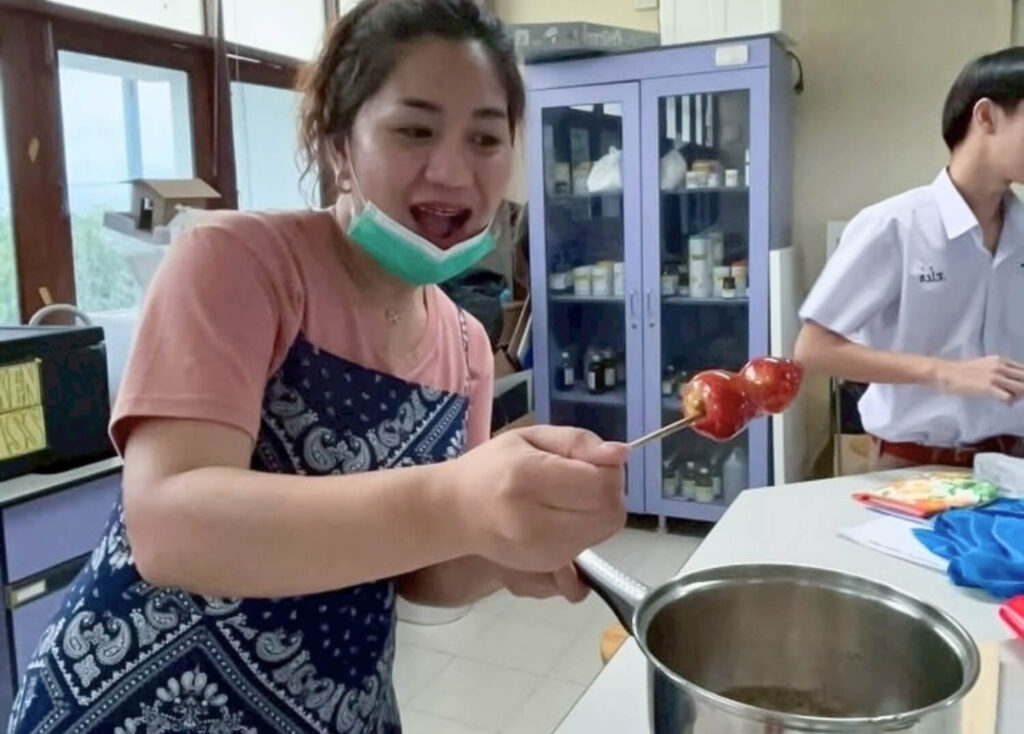
- Carefully dip the skewered fruit into the hot syrup and coat it evenly.
- Transfer the coated fruit to wax paper or parchment paper to cool and harden.
- Compare the different Tanghulu samples based on texture, thickness, hardness, shine, and stickiness.
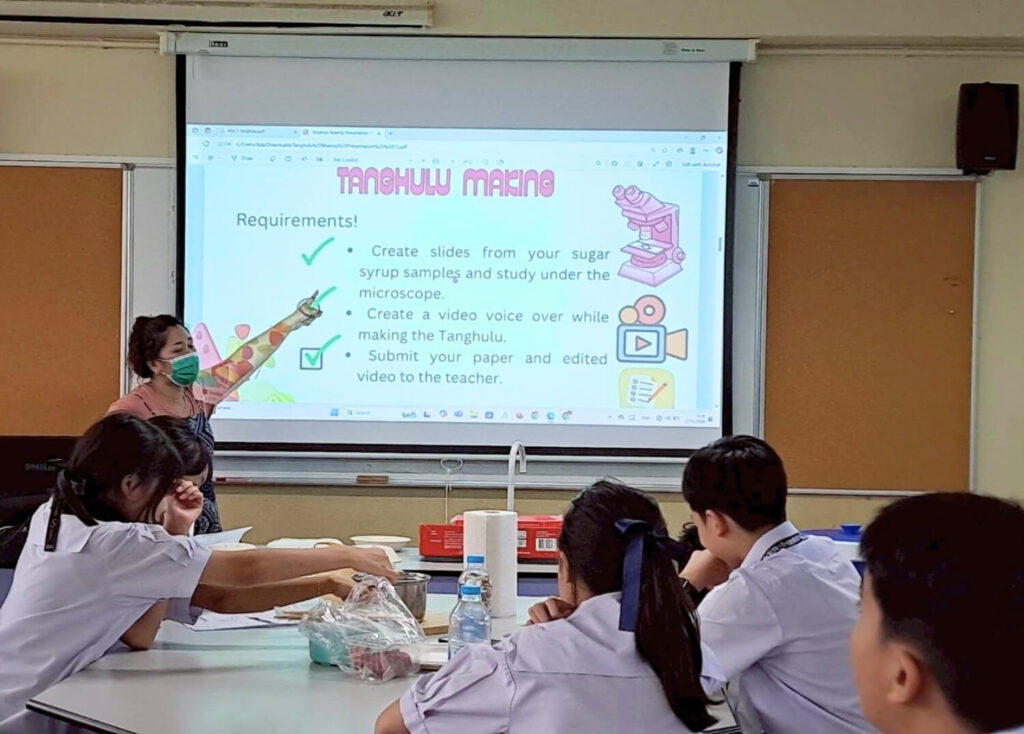
- Create slides from sugar syrup samples and observe them under the microscope.
- Record observations, prepare a short scientific explanation, and create a video voice-over while making the Tanghulu.
- Submit the paper and edited video to the teacher.
👀 Expected Observations

Students may observe:
- A glossy sugar coating forming around the fruit
- Different textures depending on sugar concentration
- Softer or stickier coating if the syrup does not reach the right stage
- Harder and thicker coating with higher sugar concentration
- Possible browning or burnt flavor if the syrup overheats
- Sugar crystals or crystal-like structures when samples are studied under the microscope
- A visible difference between the low, medium, and high concentration syrup samples
🧠 What’s Happening?
Tanghulu making demonstrates crystallization, a process in which dissolved sugar molecules come out of solution and form a solid structure. When sugar dissolves in water and is heated, the sugar molecules move freely in the syrup. As water boils away, the syrup becomes more concentrated. When the syrup cools, sugar molecules bond together and form a hard, shiny coating around the fruit.
The experiment also connects to concentration and saturation. A higher sugar concentration means more sugar molecules are present in the syrup, increasing the chance that they will bond and crystallize as the syrup cools. Temperature control is also important. If the syrup is not hot enough, the coating may stay soft or sticky. If it gets too hot, caramelization can occur too strongly, leading to a darker color, a bitter taste, or a burnt coating.
🌟 Learning Outcomes
Students can learn several important concepts and skills through this experiment:
- Crystallization
- Students observe how sugar molecules bond and form a hard coating.
- Students observe how sugar molecules bond and form a hard coating.
- Concentration and Saturation
- Students compare how different sugar-to-water ratios affect the final texture.
- Students compare how different sugar-to-water ratios affect the final texture.
- Chemical Reactions in Cooking
- Students learn how heat can change the structure and behavior of sugar.
- Students learn how heat can change the structure and behavior of sugar.
- Caramelization
- Students understand how overheated sugar can change color, flavor, and texture.
- Students understand how overheated sugar can change color, flavor, and texture.
- Molecular Bonding
- Students connect the microscopic sugar molecule behavior to the visible candy texture.
- Students connect the microscopic sugar molecule behavior to the visible candy texture.
- Scientific Inquiry
- Students test variables, compare results, and explain what caused the differences.
- Students test variables, compare results, and explain what caused the differences.
- STEAM Skills
- Students combine chemistry, food preparation, microscope observation, video production, and artistic presentation.
🎓 Classroom Notes
- This activity works best as a supervised classroom or laboratory STEAM project.
- It is especially effective for connecting chemistry to food, culture, and daily life.
- The strongest teaching value comes from comparing different sugar concentrations instead of making only one batch.
- Students should be guided to connect texture and appearance to concentration, saturation, crystallization, and temperature.
- The project also strengthens communication skills through video voice-over, documentation, and presentation.
💬 Discussion Questions
- What happened to the sugar syrup as it was heated?
- How did sugar concentration affect the Tanghulu coating?
- Which syrup concentration created the hardest coating?
- Which sample was the softest or stickiest?
- Why is temperature important in this experiment?
- What is crystallization?
- How is caramelization different from crystallization?
- What did the microscope observation show about the syrup samples?
- Why is Tanghulu a good example of chemistry in cooking?
- How does this activity combine science, technology, engineering, art, and mathematics?
🚀 Extension / Challenge
- Compare Tanghulu made with different fruits.
- Test how cooling time affects the final coating.
- Observe sugar syrup samples under a microscope and sketch the structures seen.
- Create a chart comparing low, medium, and high sugar concentrations.
- Research the molecular structure of sucrose.
- Use molecular simulation software to visualize sugar bonding.
- Compare crystallization and caramelization using real-food examples.
- Create a short video explaining the science behind Tanghulu.
- Design a presentation explaining why one batch became hard, sticky, or burnt.
- Connect the experiment to other candies such as lollipops, brittle, caramel, or fudge.
⚠️ Safety Note
This experiment involves hot sugar syrup, which can cause serious burns if handled carelessly. It should only be carried out in a controlled classroom or laboratory setting under direct teacher supervision.
Students should avoid touching the hot syrup, saucepan, or heat source, and the teacher should manage or closely supervise all heating and dipping steps. Food hygiene, allergy awareness, and careful handling of skewers should also be followed throughout the activity.
📂 Media & Resources
For downloadable files and complete teaching resources, visit our Download Center.