The Balloon and Hair Static Electricity Experiment is a simple but effective physics activity that helps students understand electric charges, static electricity, and electrostatic forces. In this supervised mini-lab, students rub a balloon on hair and observe how charge transfer affects nearby objects. It is an easy, memorable way to make electricity more visible and understandable in the classroom.
📘 Overview
Electricity is an essential topic in physics because it affects many parts of everyday life, from household power to the devices people use daily. In a laboratory setting, the study of electric charges gives students a more practical way to understand ideas that often feel abstract. Through direct observation and hands-on activity, students can better understand how charges behave, how they move, and how they influence other objects.
This activity focuses on the Balloon-and-Hair Experiment, a simple mini-lab used to introduce students to electrostatics. By rubbing a balloon on hair or another suitable material, students observe charge transfer, attraction, repulsion, and the behavior of different materials in the presence of static electricity. The experiment helps connect classroom theory to real-world examples of electricity.
🎯 Learning Objective
- Students will understand how static electricity is created through friction.
- Students will identify how electrons transfer from one material to another.
- Students will observe the attraction and repulsion of electric charges.
- Students will explain charge transfer and charge conservation.
- Students will connect the experiment to everyday examples of electrostatic forces.
🧪 Materials
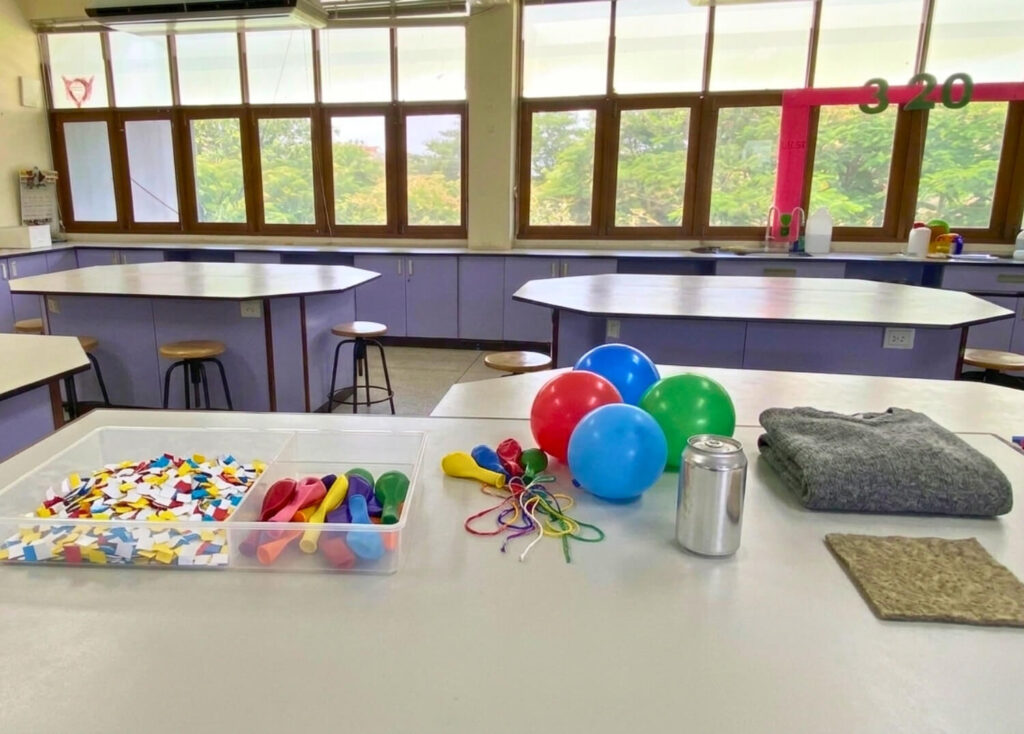
To keep the activity simple, accessible, and classroom-friendly, the materials include:
- 1 balloon
- Used to build up static charge through rubbing.
- Used to build up static charge through rubbing.
- Hair
- Used as the main material for charge transfer.
- Used as the main material for charge transfer.
- Wool sweater (optional alternative)
- Can be used if rubbing the balloon on hair is not possible.
- Can be used if rubbing the balloon on hair is not possible.
- Small pieces of paper
- Cut into tiny squares to test electrostatic attraction.
- Cut into tiny squares to test electrostatic attraction.
- Empty aluminum can (optional)
- Used to observe how a charged balloon can attract and move a lightweight metal object.
📝 Procedure
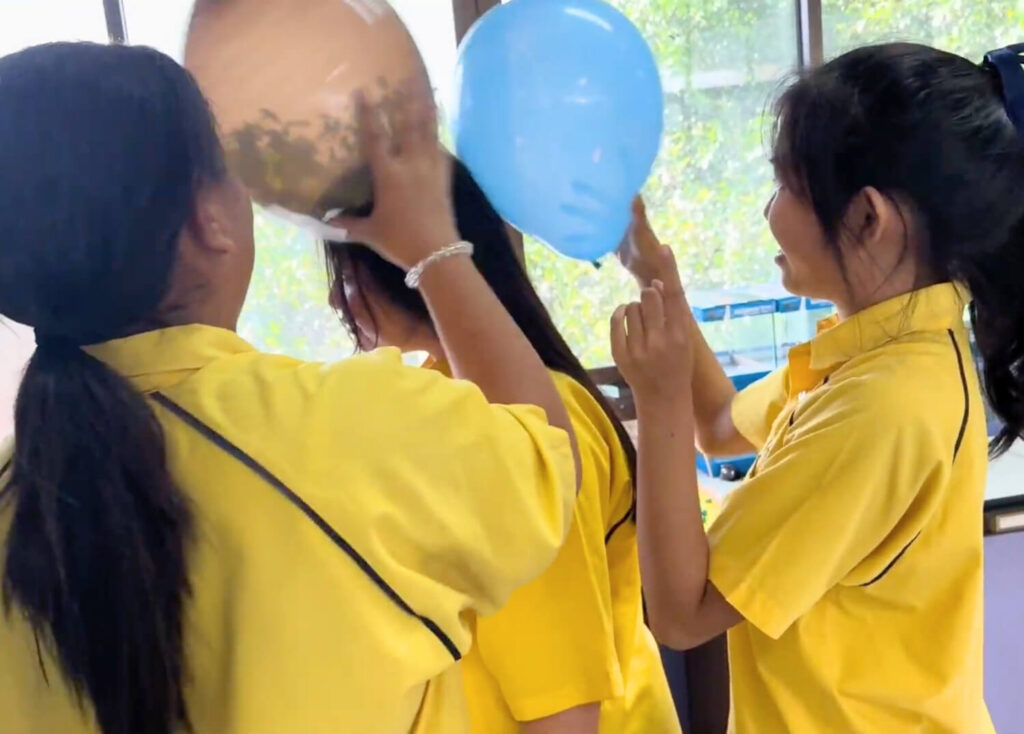
- Inflate the balloon and tie it securely.
- Rub the balloon against hair for about 10–15 seconds. If using hair is not possible, rub it against a wool sweater instead.
- Slowly bring the balloon close to the small pieces of paper without touching them.
- Observe what happens to the paper pieces.
- After observing the paper, bring the balloon near an empty aluminum can.
- Gently roll or move the balloon near the can.
- Observe how the can reacts to the charged balloon.
- Ask students to compare what happens with different materials, if available.
- Guide students to describe the attraction or movement they observe.
- Use the observations to discuss charge transfer, electrostatic force, and why the effects weaken over time.
👀 Expected Observations
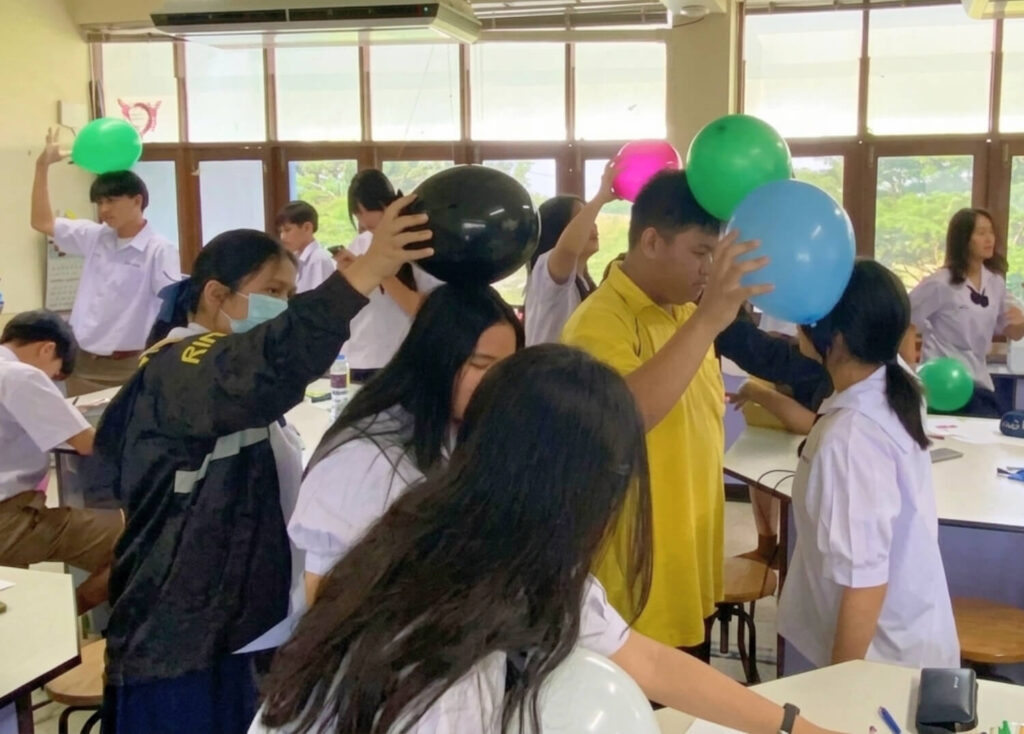
Students may observe:
- Small paper pieces moving toward the balloon
- Hair strands standing up or moving toward the balloon
- Hair strands repelling one another after becoming similarly charged
- The aluminum can rolling toward the balloon
- The attraction effect becoming weaker after some time
- Different materials producing different levels of static charge
🧠 What’s Happening?
When the balloon is rubbed on hair, electrons move from one material to another. In many cases, the balloon gains extra electrons and becomes negatively charged, while the hair loses electrons and becomes positively charged. This charge imbalance creates static electricity.
Because opposite charges attract, the negatively charged balloon is pulled toward the positively charged hair. Neutral objects, such as small paper pieces or an aluminum can, can also be attracted because the balloon causes charges inside them to shift slightly. This makes the experiment a strong example of charge transfer, electrostatic attraction, and polarization.
The activity also shows that static charge is temporary. Over time, the charge gradually weakens as it interacts with surrounding air and other objects.
🌟 Learning Outcomes
Students can learn several important concepts through this experiment:
- Static Electricity
- Students see how friction can create a temporary electric charge.
- Students see how friction can create a temporary electric charge.
- Charge Transfer
- Students observe that electrons can move from one material to another.
- Students observe that electrons can move from one material to another.
- Attraction and Repulsion
- Students learn that opposite charges attract and that similar charges repel.
- Students learn that opposite charges attract and that similar charges repel.
- Charge Conservation
- Students understand that charge is transferred, not created or destroyed.
- Students understand that charge is transferred, not created or destroyed.
- Triboelectric Effect
- Students discover that some materials gain or lose electrons more easily than others.
- Students discover that some materials gain or lose electrons more easily than others.
- Electrostatic Force
- Students observe that charged objects can influence nearby objects without direct contact.
🎓 Classroom Notes
- This mini-lab works especially well as an introductory activity for electric charges and electrostatics.
- It is effective because students can directly see the effects of charge transfer.
- The strongest teaching value comes from combining observation with explanation.
- Students can compare how different materials affect the strength of the static charge.
- This experiment also helps connect abstract physics ideas to familiar real-world situations.
💬 Discussion Questions
- Why does rubbing the balloon on hair create static electricity?
- What happens to electrons during the experiment?
- Why does the balloon attract small pieces of paper?
- Why can the balloon attract an aluminum can?
- Why do strands of hair sometimes stand up?
- What is the difference between attraction and repulsion in this activity?
- Why is the balloon usually negatively charged after rubbing?
- Why does the effect of static charge weaken over time?
- How would different materials change the result?
- Where can we observe similar examples of static electricity in daily life?
🚀 Extension / Challenge
- Test the balloon with wool, silk, cotton, or polyester and compare the results.
- Create a simple chart showing which material produces the strongest attraction.
- Compare what happens with paper pieces and with an aluminum can.
- Explain how the triboelectric effect helps describe the results.
- Research how static electricity is used in air filters, painting, or photocopying.
- Observe whether dry weather changes the strength of the effect.
- Draw a simple diagram showing charge transfer between the balloon and hair.
- List three real-world examples of electrostatic attraction.
- Explain how this mini-lab connects to Coulomb’s law.
- Reflect on why simple experiments can make difficult science concepts easier to understand.
⚠️ Safety Note
This experiment is generally very safe, but students should be careful around electronic devices, since static electricity can sometimes affect sensitive equipment. The activity should be carried out in a controlled classroom setting, and students should avoid bringing the charged balloon too close to phones, tablets, computers, or similar electronics. Dry conditions may also cause static charge to build more easily.
📂 Media & Resources
For downloadable files and complete teaching resources, visit our Download Center.








![[BFITS] BrightMinds Series_The Future is Yours KickOff Session on Expert Insights for Your Future Career with Mr. Suthichai Yoon](https://bfitsthailand.com/wp-content/uploads/2025/01/BFITS-BrightMinds-Series_The-Future-is-Yours-KickOff-Session-on-Expert-Insights-for-Your-Future-Career-with-Mr.-Suthichai-Yoon-300x109.jpg)